Author: subir

Consumption, savings and unemployment

Consumption, savings and unemployment

The Grasshopper and the Ants

Though we remain optimistic about the prospects for US growth over the longer-term, and continue to believe in the diversity and resiliency of the US economy, it is difficult to see much optimism in the short to medium term. Over the past few weeks, we’ve been delving into unemployment statistics at the state and local level to get a better sense of how bad this recession has been for employment.
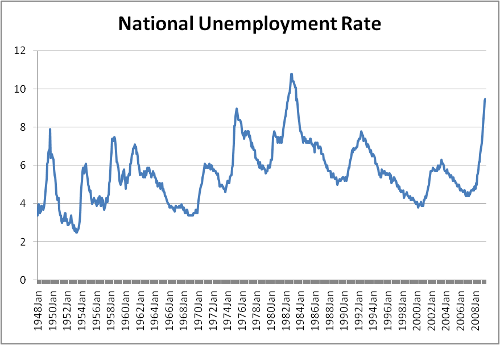
US unemployment rate (1948 onwards)

The national unemployment rate in June was 9.4%. With the exception of the recession of 1982-1983 (when it reached 10.8%), this is the worst unemployment rate in the post-second world war period. At a regional level, in nine states, the current unemployment rate is the highest since 1976 (the earliest year data is available at the BLS), and in another eight states (plus D.C.) it is within one percentage point of the record. Amongst those setting records, are two of the largest state economies CA and FL (also those worst affected by the real-estate boom, and a wide-swath of mid-atlantic states, MD, VA, GA, NC, SC. So in 18 of 50 states, joblessness is higher than most people have ever experienced. In absolute terms, more of the labor force is unemployed now (15.2 million) than at any time since 1948.

It is likely that unemployment will continue to rise until early 2010, and the unemployment rate could well exceed that of 1982-1983 and reach 11%. The primary reason for our pessimism about the speed and strength of a recovery is the shaky ground on which US households find themselves. Years of low and negative savings rates combined with falling asset prices have affected the biggest components of US household wealth, our homes and investments. The reverberations of this wealth effect will be felt for many quarters of US consumption and consumer confidence.

Unemployment affects consumer confidence in a way that GDP figures and corporate profits cannot. Continuing unemployment, seeing friends or neighbors out of work for months on end, makes consumers rethink every purchase.
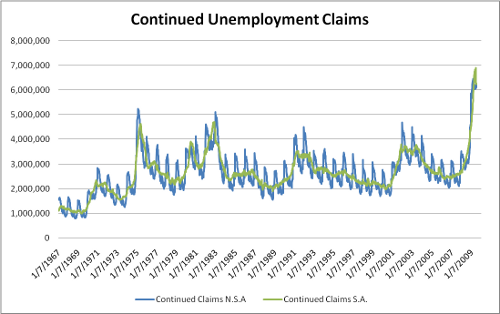
Continued Unemployment Claims (1967 onwards)

Since we do not foresee a quick recovery in consumer demand, we believe a quick recovery in unemployment to the 5-6% level is unlikely. In prior recessions of similar severity, unemployment has not returned to the 6% range till 3-4 years have passed. This would suggest a return to full-employment in 2012 or 2013. It may take longer. We believe a structural adjustment is underway, with two sectors of the economy, construction and finance, shrinking to a semi-permanent lower level of activity. Former workers from these industries will need to retool themselves for work in other areas, or may need to relocate to another part of the country. This will take time.

The unwelcome triplet of rising unemployment, falling asset prices, and a financial crisis that has felled many firms that were household names will affect the American consumers’ view of thrift and spending for years to come. We believe the current recession’s affect on US consumer behavior will be long-lasting, as will the US investor’s new-found skepticism towards real-estate, debt and equities. This is similar to how a traumatic episode affects survivors. For an entire generation of Americans, this recession is their first encounter with generally difficult economic conditions and the realities of the business cycle. We believe there is a fundamental shift underway for a generation of Americans, away from a culture of high consumption, towards a new-found frugality.

The grasshoppers are chastened and the ants have been vindicated in particularly dramatic fashion.


U.S. Financial Regulatory Reform: The Investor’s Perspective

U.S. Financial Regulatory Reform: The Investor’s Perspective

The CFA Institute published a report last month outlining broad recommendations for regulatory reform in the US Securities markets. It covers numerous topics that have bubbled into the public discourse, including systemic risk, accounting standards, derivatives regulation, compensation standards, unregulated entities and budget certainty for regulators. We feel the paper is a must read for investors and anyone interested in continued prosperity through effectively functioning markets.

The road ahead…

The road ahead…

We read Bill Gross’ monthly letters for his thoughtful take on the big economic and financial questions of the day, mixed in with a dose of humor. The NYT recently published a profile of Gross, whose reputation has been burnished during this crisis. The June 2009 and July 2009 letters are a must read for their colorful description of the long road ahead of us, before the world economy attains some semblance of normalcy.

The ground shifts under efficient market theorists.

The ground shifts under efficient market theorists.

In Hans Christian Andersen’s tale The Emperor’s New Clothes, a pair of confidence tricksters sell the king a suit made of fabric so special, it was invisible…

The more things change, the more they stay the same. For years, the priesthood of academic economics had the entire world convinced that the markets conformed to the “semi-strong” form of the Efficient Markets Hypothesis. Mathematical concepts taught in introductory engineering courses entranced “social scientists” into promoting a tautology that did not conform with even a cursory knowledge of history.

It seems, though, that Efficient Markets Hypothesis might be going the way of the dodo, since it elicits amused smiles from most observers when they hear the name. The Times ran a story this week, Poking Holes in a Theory of Markets, and interviewed the inimitable Jeremy Grantham, whose market views we follow closely. The article’s worth a read if only to get a little bit of a taste of Grantham.

The two bubbles (technology stocks and real-estate) we have suffered this decade have brought into question a number of preconceived notions and assumptions about how the world works. It’s heartening for us to see a resurgence of interest in economists whose work stands apart from the Chicago orthodoxy. It’s good to see a little bit of attention being paid to behavioral economics, Keynes, Schumpeter, and Hayek.

Prices are crucial carriers of information in a capitalist economy, they tell us what the prevailing opinion is in the marketplace. Prices convey to market participants what the odds offered at a racetrack tell bettors. In general the crowd is right about the odds for companies and horses, but on occasion, it is spectacularly, violently, destructively wrong.

Asset prices are useful when they reflect the collective, informed opinion of participants who use independent judgment and analysis to arrive at an independent sense of value. The moment a large enough contingent believes market prices tell them everything there is to know about the world, that there is no purpose in doing their own analysis, and begin to trade indiscriminately, prices become less than useless. Market prices are opinion, and this opinion is meaningful and useful when your market is composed of knowledgeable investors attentive to risk. When the market is taken over by speculators and most participants are too lazy to analyze a security in an intellectually honest way, prices no longer tell you anything but how much punch has been consumed at the party.

Eventually, someone points out that the emperor is naked, and the ground shifts. EMH RIP.